
- Much higher bandwidth and future scalability – Fiber supports up to ~100 Tbps and has a much longer useful life, whereas copper is limited to ~10 Gbps and needs more frequent upgrades.
- Significantly longer transmission distances – Fiber can run 30 km+ versus copper’s ~100 m limit, enabling easier campus-wide connectivity with fewer network points.
- Longer lifespan and lower replacement needs – Fiber typically lasts 20–30+ years, while copper often requires replacement every 5–8 years.
- Reduced space and infrastructure requirements – Fiber can eliminate many telecom rooms and reduce building space needs by up to 90%.
- Lower power consumption and cooling demands – Fiber uses about 2 watts per user vs. 10 watts for copper and often eliminates the need for HVAC cooling.
- Higher reliability and uptime – Fiber networks can achieve ~99.9999% uptime with minimal signal degradation compared to higher downtime in copper networks
Benefits of Fiber Optic/ PON-OLAN
Comparison
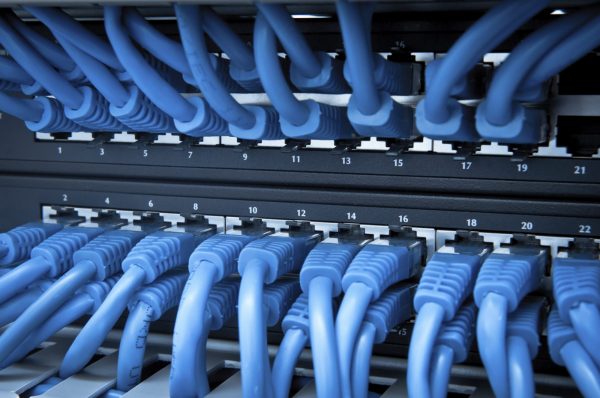
Why Copper is Still Widely Used?
While fiber is superior in most ways, copper is still widely used because of practical trade-offs. Here’s why some organizations still choose it:
- Lower upfront cost (for small/simple setups): Copper cabling and equipment are often cheaper to buy and install initially, especially for short runs or smaller networks. Fiber’s savings tend to show up over time, not always on day one.
- Good enough performance for some use cases: Copper can deliver up to 10 Gbps over 100 m, which is sufficient for many offices, retail environments, or basic enterprise needs.
- Easier installation and familiarity: Copper is simpler to terminate, troubleshoot, and install. Most IT teams are already trained on it, while fiber may require more specialized skills and tools.
- Existing infrastructure: Many buildings already have copper installed. Reusing it avoids the cost and disruption of a full upgrade, especially if performance requirements haven’t outgrown it yet.
- Power over Ethernet (PoE): Copper can deliver both data and power over the same cable (for phones, cameras, Wi-Fi APs). Fiber can’t do this without additional hardware.
In Summary
Fiber is the better long-term, high-performance, and scalable solution, especially for large campuses or future-ready networks.
Copper remains popular because it’s cheap, familiar, and “good enough” for shorter distances and less demanding environments.
Ready to upgrade? Let's connect.
If you’re interested in upgrading your network with fiber or copper, we can help you find the solution best for your organization. Alternative communication:
Phone: 630.941.6000
Email: info@pentegrasystems.com
Address: 1400 Shore Road, Naperville, IL 60563
Thank you for your message.
It has been sent! 
It has been sent!